The Song of the Cricket
An interdisciplinary initiative using modular floating islands to restore biodiversity by reintroducing invertebrates and rebuilding food webs.
Cluster
Research partners
The Urban Ecology and Design Lab (UEDLAB), University of Melbourne – Faculty of Architecture, Building, and Planning in collaboration with the Fondazione Museo Civico di Rovereto, Italy; along with the Melbourne Conservatorium of Music; School of Biosciences; Centre for Spatial Data Infrastructures and Land Administration; School of Computing and Information Systems, Esapolis Grande Museo Vivente degli Insetti, World Wildlife Fund, Oasi Valle Averto, Pevere, Parco del Mincio, ARUP (Sound Lab, Lighting and Ecology), Fab Lab, Machine Workshop and Maker Spaces, WET Systems, Aflex Technology (New Zealand) Biomatrix Water (Scotland), Parks and City Greening Branch at City of Melbourne, Australia, DAFNAE, Università Degli Studi di Padova, Musée National d’histoire naturelle Luxembourg
Project team (University of Melbourne)
Professor Alexander J. Felson (Architecture, Building and Planning); A/Professor Miriama Young (Music Composition); Professor Theresa Jones (Bio Sciences); A/Professor Alice Kesminas (Infrastructure Engineering); A/Professor Jagannath Aryal (Infrastructure Engineering); Professor Ary Hoffmann (Bio Sciences); Professor Margaret Mayfield (Bio Sciences); Professor Michael Kearney (Bio Sciences); Professor Michael Shawn Fletcher, Professor Natalie King and Senior Lecturer Sofia Colabella and Will Carter (Indigenous Knowledge)
Project team (outside the University of Melbourne)
Filippo Maria Buzzetti (Fondazione Museo Civico di Rovereto), Enzo Moretto, Esapolis Grande Museo Vivente degli Insetti
Contact
For music composition: A/Professor Miriama Young
Project summary
The project centres on the Adriatic Marbled Bush-Cricket, an endangered species native to the Venice Lagoon, northeastern Italy, and Slovenia. Once thought extinct, it was rediscovered in the 1990s in isolated reed-bed ecosystems. The species inhabits both salt and fresh water at the land-water interface in fringe marshes. These intertidal and seasonal wetland zones are facing increasing impacts from climate change and sea level rise as well as the side effects of flood defences, land use change and urbanisation. The crickets with their seasonal chirping provide a unique opportunity to record and utilise their songs as a bio-indicator of wetland health. Recordings over time can link biodiversity loss with habitat degradation and rising sea levels.
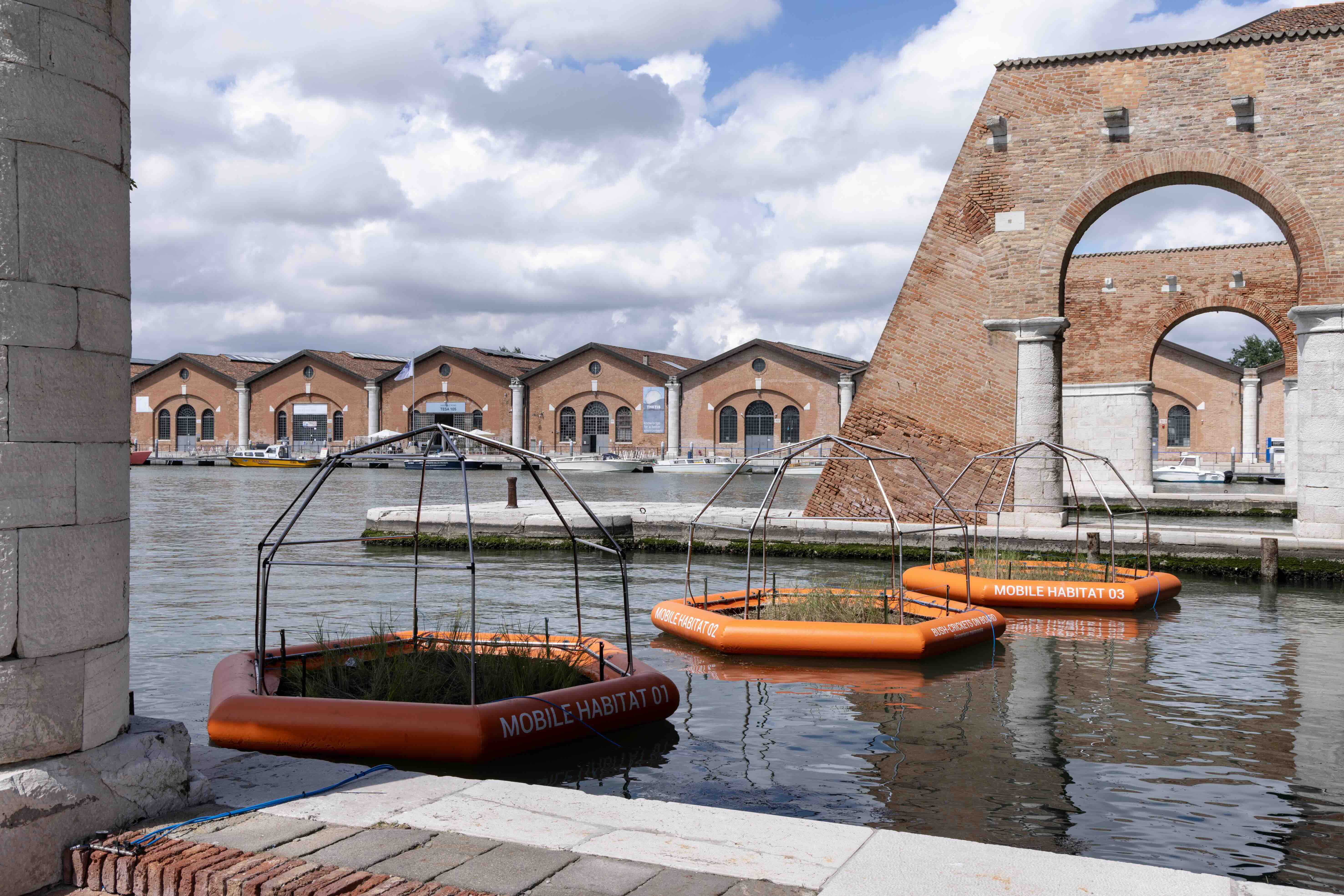 Song of the cricket rafts, 19th International Architecture Exhibition – Venice Biennale 2025. Image: Marco Zorzanello.
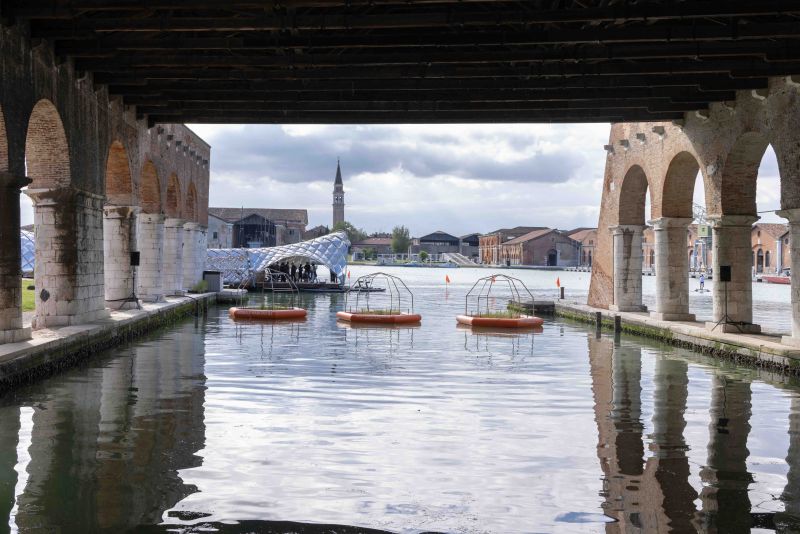
Song of the Cricket is a living ecological artwork and conservation intervention. At its core is a celebration of the life cycle of the organism from the nymph stage through to reproductive chirping adults and breeding, and death of the adults. Habitat enclosures were provided to support this stage bringing the cricket’s song back into the Venice Lagoon context for the first time in decades. In addition to its ecological aims, the project features sound installations. An immersive “sound garden” brings the sound-habitat of the crickets into the Venice Biennale for visitors and crickets to enjoy. A second performance drawing on bioacoustic research and artistic composition plays in concert with the cricket and invites visitors into a sensory experience that connects natural soundscapes with ecological education and meaning. Underneath the roof where the cricket inspired composition pays are three modular floating islands – portable breeding habitats designed to support small, isolated populations of the endangered Adriatic Marbled Bush-Cricket (Zeuneriana marmorata). These habitats improve food, water, and nesting conditions for the species, enabling breeding and lifecycle completion while reducing predation and disease. Visitors also have the opportunity to explore cricket sounds from their own homes under the large roof using the Global Cricket Sound installation.
About the Venice Biennale
Held every two years in Venice, Italy, the Architecture Biennale attracts tens of thousands of visitors from around the world and provides a high-profile platform for experimental research and public engagement across disciplines. In 2025, under the curatorial theme Intelligens: Natural. Artificial, the Biennale showcased over 300 projects that bridged environmental, technological, and social concerns.
Melbourne Biodiversity Institute support and impact
The MBI provided key funding support for Song of the Cricket, enabling participation by University of Melbourne researchers and artists in this globally visible exhibition. MBI’s contribution helped integrate biodiversity science with landscape architecture and ecological design, sound art, and community engagement – a demonstration of MBI’s commitment to interdisciplinary collaboration and public impact. The project exemplifies the Institute’s mission to advance innovative biodiversity solutions that resonate with both scientific and broader cultural audiences.
Goals of the project
- Unveil a real world living lab as a landscape art and sound exhibition that celebrates the cricket’s lifecycle and song aesthetically and functionally towards conservation goals.
- The cricket’s song serves as a bioindicator of species and ecosystem health, highlighting the impact of climate change and habitat loss.
- Support breeding and reintroduction of Zeuneriana marmorata in the Venetian lagoon.
- Demonstrate modular ecological designed experiments design as a tool for habitat restoration.
- Engage diverse public audiences through sound, space, and ecological storytelling.
- Strengthen interdisciplinary research models linking ecology, design, art, and engineering.
Interdisciplinary collaboration
Song of the Cricket embodies highly interdisciplinary research and practice:
- Australia - Italy International Collaboration: Bridging approaches to species reintroduction, habitat and food web enhancements are at the heart of this international exchange. A project focusing on Matchstick Grasshopper reintroductions into Royal Park in Melbourne, Australia, provided the basis of the Song of the Cricket. Exchange of approach continues to evolve.
- Landscape Architecture & Design for Biodiversity: The exhibit is situated across the land-water interface celebrating where these crickets live and areas facing future flood risk.
- Fine Arts & Music: A composer from FFAM working with ARUP and SCIS to combine music, wetland sounds and cricket songs to create a living sound garden supporting education around bioacoustics and supporting insects breeding in the enclosures.
- Bioacoustics: The exhibition features sound design and artistic interpretation of natural and amplified cricket songs and wetland soundscapes enriching the natural-civic space engagement.
- Cultural knowledge: The discovery of a pair of crickets (likely male and female breeding) in the mosaic floor of the Basilica of Santa Maria e San Donato in Murano, Venice (1141) encouraged further exploration into insect culture and history. The crickets are documented in writing and texts. We connected with the Indigenous Knowledge Institute and with Geography Earth and Atmospheric Sciences to explore cultural knowledge through Indigenous lenses in Australia and related this to Italy.
- Ecology & Biosciences: Experimental breeding, ecological monitoring, and habitat rehabilitation strategies guided scientific outcomes.
- Engineering & Geospatial Data: Technical input on modular design, geospatial planning, and fabrication supported operational feasibility.
- Operations & Maintenance: Technical input on modular design, geospatial planning, and fabrication supported operational feasibility.
Project reach and public engagement
- Installed at the Arsenale, one of the central exhibition venues of the Biennale, the project was viewed by international audiences, researchers, and practitioners over six months (May-November 2025).
- The exhibit introduced the public to the endangered species and its habitat needs, including its location at the land-water interface, its reliance on Phragmites sap and what it eats.
- Through its sensory experience and ecological narrative, it attracted visitors beyond architecture circles, including biodiversity advocates, cultural and local and international audiences.
- By combining scientific inquiry with artistic expression, Song of the Cricket communicated complex biodiversity issues in accessible, experiential ways, widening public understanding of species conservation and ecosystem health.
- The project introduced the crickets as food web catalysts for rehabilitating ecosystems.
- The project also emphasised the value of the cricket’s song as a bioindicator of population and ecosystem health.
- The project catalysed a longer term rehabilitation initiative starting with a viable translocation of crickets back into the Venice Lagoon.
- The proposal introduced a way of fostering biodiverse food webs through public designed experiments using species translocations as art installations and public space making.
Further work
In November 2025, the team presented at the Gens Public Programme Speakers Corner “Intelligens Legacy: How the Exhibition Lives On,” as part of the closing day culmination of the 19th International Architecture Exhibition. At the end of the exhibition, a core team deconstructed the exhibition and moved the eggs along with the vegetation and biomass from the enclosures onto the mobile habitats that were placed along managed canals running through the WWF Oasi Valle Averto, which is recognised by the Ramsar Convention as a “Wetlands of International Importance” and is part of two Natura 2000 sites. The egg populations were transported from low, medium and high diversity enclosures into separate mobile habitats and spaced to avoid any overlap as the populations emerge. In this way, the research strategies pioneered by the project, particularly modular habitat design and bioacoustic engagement, are being adapted to a local biodiversity context as a comparative experiment.
Plans are now underway to hold an exhibit at the Esapolis Museo in May 2026. The Museo is working with Filippo Buzzetti and the University of Melbourne to monitor the transition from eggs to nymphs in April and May. The team is using the pilot research and initial translocation into the lagoon, as a means to advance the project’s ecological objectives beyond the Biennale and set up a pilot translocation that can be used to show government officials and potential funders how the crickets can bring life back to the lagoon. The goal is to build a viable foundation population at Oasi Valle Averto, and to use this population to rehabilitate multiple sites across the lagoon. The long term vision is to present the cricket populations as a surrogate for ecosystem health using bioacoustics as a means to monitor the populations, and to present this to the Water Authority of Venice as a way of informing the impacts of the Mose Flood defense system. The researchers would continue to use the mobile habitats as life rafts to move the populations to new locations for years to come. The rafts provide a ceremonial transport and relocation of the incubated cricket eggs to these selected rehabilitation sites, as a continuation of the conservation work initiated in Venice.
Outputs / Activities
- Harvard University Graduate School of Design News. When the High Tech Abounds, the Low Tech Shines: A Review of the 2025 Venice Architecture Biennale
- The Conversation (AUS/International)
- Melbourne School of Design, Atrium
- Urban Ecology and Design Lab
- Sound element
- Deltas of Change (Symposium), THE NEW INSTITUTE Centre for Environmental Humanities (NICHE) at Ca' Foscari University of Venice. 18 June 2025. Visit to the exhibition and multi-disciplinary presentation on the ECO-TONE: ‘Song of the Cricket’
- Landscape Architecture Magazine (USA)
- International Federation of Landscape Architecture – Asia-Pacific Region (IFLA-APR) Talk & Share Series, 9 July 2025
- Melbourne Connect, 2-4 September 2025
- GreenProphet
- Landscape Architecture Magazine December 2025