Sunbury Rail Line Native Grassland Restoration Trial
Partnering with Metro Trains, this project tested practical approaches to restoring critically endangered Victorian Volcanic Plains grassland within an active rail corridor along the Sunbury line.
Research partners
Metro Trains, Merri Creek Management Committee
Project team
Professor Nicholas Williams, Dr Zahra Saraiean, Sophia Blosfelds, Professor Stephen Livesley, John Delpratt, Dr Julian Brown, Dr Katherine Horsfall, Ben Roberts (Metro Trains), Michael Longmore (MCMC), Professor Brendan Wintle, Dr Andrew Rogers, Stephanie Chen, Joliette Cooper-Booth, Professor Martine Maron (University of Queensland)
Contact
Project details
To achieve the Infrastructure Sustainability Council (ISC) accreditation required for the Melbourne Metro Tunnel project, Metro Trains voluntarily undertook to restore 3 ha of the critically endangered Victorian Volcanic Plains native grassland along the Sunbury rail line. To determine the most effective restoration method to use within the constraints of the rail corridor operating environment Metro partnered with the project team to compare “scalp and sow” versus “cap and sow” grassland restoration techniques.
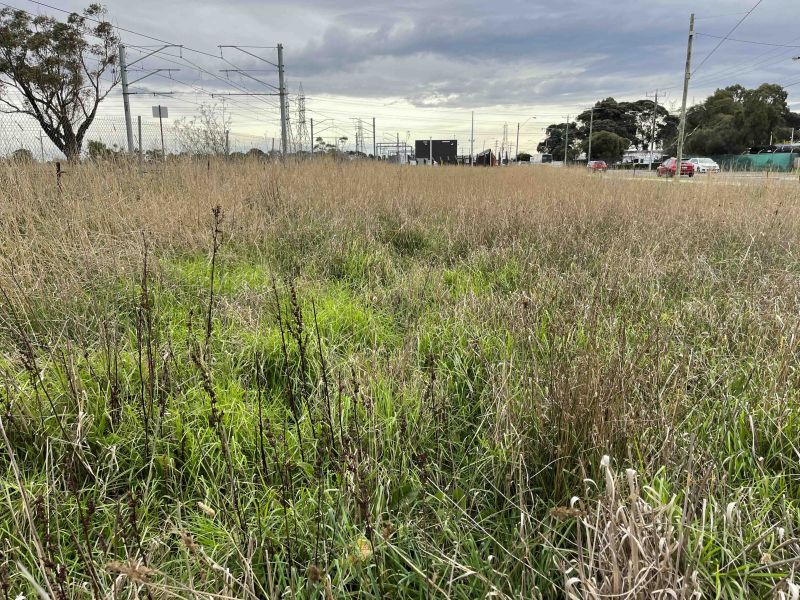
The trial site is on the rail reserve adjacent to St Albans Road at Ginifer. In the 1980s it was a native grassland, but disturbance associated with the construction of the Western Ring Road and absence of management led to the total loss of native vegetation and it was now dominated by invasive weeds. Following weed control, half the site was scalped by a 20 ton excavator that removed the top 15 cm of nutrient rich, weed seed containing topsoil, while the other half was capped with a low-nutrient weed free clay subsoil recycled from the construction of a car park at Watergardens station. We directed seeded two different seed mixes of high and low wildflower richness onto the capping and scalping treatments in April 2024. Wildflower seeds were grown in a dedicated Seed Production Area established at the Burnley campus. To evaluate success, vegetation surveys of the 4 treatments were undertaken in Nov 2024 and Nov 2025.
Survey results demonstrated that 18 months after sowing a native grassland community that meets the EPBC listing criteria for Natural Temperate Grassland of the Victorian Volcanic Plain has been constructed. The capping treatment outperformed scalping, achieving significantly higher grass cover and lower weed cover, particularly in the high diversity mix plots. However wildflower species richness was significantly higher in the scalped high diversity mix treatment than the capped biodiversity mix treatment in both 2024 and 2025
The goals of our project
- To establish a diverse native grassland that meets the EPBC listing criteria for the vegetation community
- Evaluate the relative effectiveness of the “scalp and sow” and “cap and sow” restoration techniques using diversity and cover metrics.
- To better understand the operational and technical constraints of undertaking native grassland restoration in a busy rail corridor
Outcomes/Activities
- 3 ha of restored native grassland in rail reserves at Ginifer, Sydenham and South Sunbury.
- Established new populations of Nationally and State listed rare species including Rutidosis leptorrynchoides (Button Wrinklewort), Leucochrysum albicans (Hoary Sunray) Podolepis linearifolia (Basalt Podolepis)
- Project learnings were included in a Victorian Infrastructure Delivery Authority Urban Design Technical Report that aims to simplify vegetation establishment and reduce landscape costs across the VIDA Rail projects using direct seeding instead of tubestock planting.
- Conference presentations at World Biodiversity Forum, EIANZ ANET conference, Australian Association of Bush Regenerators Grassland Resurrection Forum, presenter Nick Williams.
- Media placement: Metro Trains
Get in touch with the research team
- nsw@unimelb.edu.au